Guide
How to Eat and Serve Caviar: A Beginner’s Guide
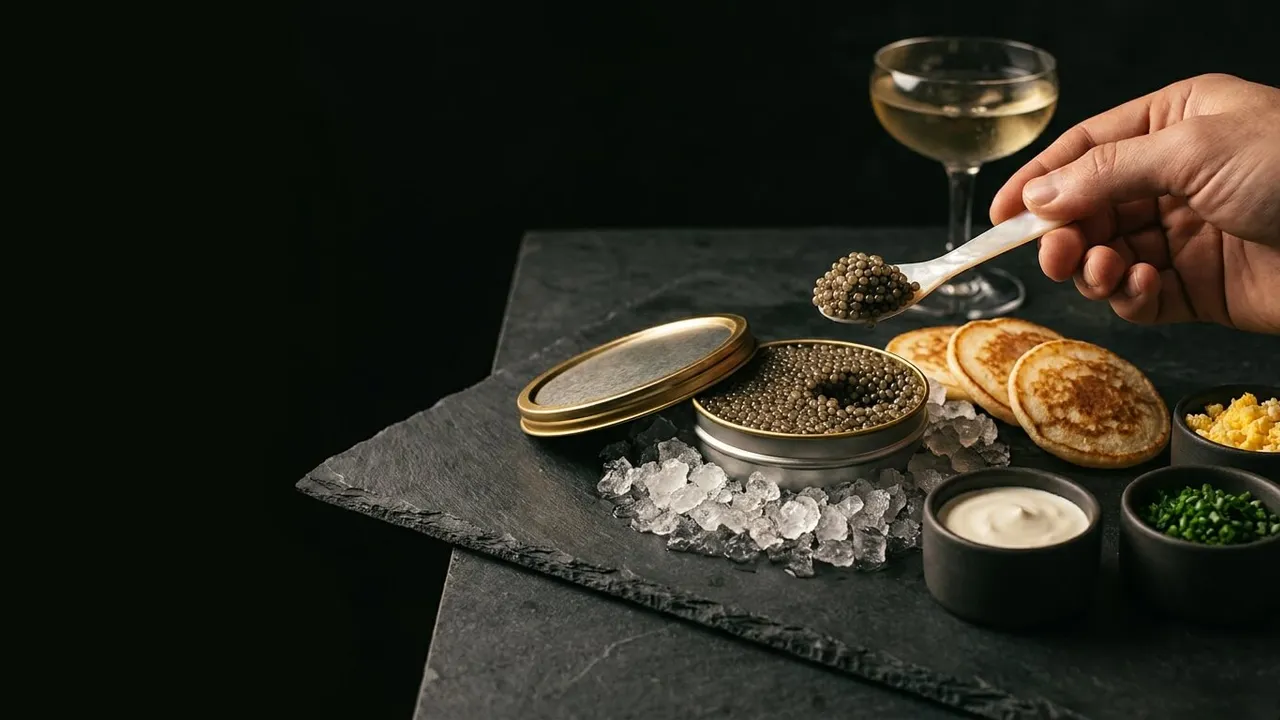
Serve caviar cold, in its tin, on crushed ice, with a mother-of-pearl spoon. Allow 12 to 15 grams per person as an appetiser. Eat the first spoonful plain, straight from the spoon, before you touch a blini. There are fewer rules than people pretend, and only two of them matter: keep it cold, and keep metal away from it.
Reviewed by Awers Inc. — 6 August 2026. Awers Inc. has cured and packed its own caviar in Bellevue, Washington since 1995.
How to serve caviar, step by step
Serving caviar takes 15 minutes of preparation and no equipment beyond a bowl of ice.
- Keep the tin refrigerated until 15 minutes before serving. Caviar is served at 28 to 32°F, the temperature it is stored at.
- Fill a shallow bowl with crushed ice and nest the unopened tin into it. A ramekin inside a larger bowl works.
- Open the tin at the table. Slide a butter knife or a caviar key under the lip and lift. Presentation is half the point, and an opened tin loses texture from the first minute.
- Serve from the tin. Do not decant caviar into a serving dish. Every transfer crushes pearls.
- Give each guest a mother-of-pearl, bone or horn spoon. Never metal.
- Take the first spoonful plain. Press it against the roof of your mouth rather than chewing. The pearls should pop, not crunch.
- Reseal and refrigerate anything left within the hour. Opened caviar keeps 48 hours.
How much caviar per person?
Allow 12 to 15 grams of caviar per person as an appetiser, or 30 grams per person if caviar is the centre of the course. Most first-time buyers order half what they need and then apologise for it.
| Tin | Appetiser, 12–15 g | Centrepiece, 30 g |
|---|---|---|
| 100 g (3.5 oz) | 6–8 people | 3–4 people |
| 200 g (7 oz) | 13–16 people | 6–7 people |
| 250 g (8.8 oz) | 16–20 people | 8 people |
| 454 g (1 lb) | 30–37 people | 15 people |
One heaped spoonful is about 5 grams. A 30 gram portion is six generous spoonfuls, which sounds like plenty and disappears in about four minutes.
For a dinner party where caviar opens the meal, a 100 gram tin serves six comfortably. For two people making an occasion of it, a 100 gram tin is generous and a 50 gram tin is correct.
What spoon should you use for caviar?
Use a mother-of-pearl, bone, horn or plastic spoon. Never silver or stainless steel. Metal oxidises on contact with the roe and adds a distinct metallic note within a minute or two. It is the one avoidable way to ruin an expensive tin.
Mother-of-pearl is traditional because it is inert, non-porous and does not conduct heat into the roe. A cheap plastic spoon does the same job less beautifully. Wood works, though it can carry flavour.
The rule extends to the tin. Do not leave any spoon sitting in the caviar between servings, and do not use a metal serving dish. Glass, ceramic and the tin itself are all fine.
What do you eat caviar with?
Eat caviar plain first, then with a neutral starch and something cold and slightly sour. The classic three are blini, crème fraîche and chopped egg. The best accompaniment is whatever carries the roe without competing with it.
| Accompaniment | Why it works | Note |
|---|---|---|
| Plain, on the spoon | Nothing between you and the caviar | Always do this first |
| Blini | Warm, neutral, slightly yeasty | Serve warm, not hot |
| Crème fraîche | Cold, sour, high fat | Never sweetened |
| Toast points | Neutral, crisp | Unbuttered or lightly buttered |
| Plain potato chips | Salt, fat, crunch | Kettle-cooked, unflavoured |
| Boiled egg, chopped | Rich, mild | Whites and yolks separately |
| Chives, finely cut | Fresh, mild allium | Restraint |
| Baked potato | Warm, starchy, forgiving | A whole course on its own |
| Buckwheat blini with sour cream | The Russian standard | Sour cream, not crème fraîche |
Potato chips deserve their reputation. A plain kettle-cooked chip with crème fraîche and a spoonful of Ossetra is one of the best ways to eat caviar. Half the industry pretends otherwise because it does not look expensive. Use unflavoured chips with visible salt crystals and no seasoning.
What should you not serve with caviar?
Avoid anything acidic, sweet, strongly flavoured or metal. This is a shorter list than the accompaniment list and it does more work.
- Lemon. Acid curdles the flavour and flattens the finish. The lemon wedge on restaurant caviar service is a garnish for tinned fish, not for good roe.
- Raw onion. Overwhelms everything. Chives if you must.
- Strong cheese. Competes and wins, for the wrong reasons.
- Vinegared rice or pickles. The acid does the same damage as lemon.
- Sweetened crème fraîche or flavoured crackers. Sugar and caviar do not meet well.
- Metal spoons, forks and serving dishes. Covered above, and worth repeating.
- Anything hot. Heat cooks the roe. Add caviar to a warm dish at the table, never during cooking.
What to drink with caviar
Drink brut Champagne or a clean, cold vodka. Both work for the same reason: they are dry, cold and carry no competing flavour, so they reset the palate between spoonfuls.
Champagne should be brut or extra brut. Anything off-dry fights the salt. Blanc de blancs is a good default.
Vodka should be served from the freezer in small measures. This is the Russian pairing and the older of the two.
If neither appeals, a dry unoaked white works. Chablis, Muscadet and dry Riesling all have the acidity and restraint the job needs. Avoid oaked Chardonnay, red wine and anything sweet.
Your first tin: a timeline
Serving caviar for the first time is a scheduling problem more than a skill problem. Here is the whole sequence.
- The day before. Confirm the caviar is in the coldest part of the refrigerator, at the back of the bottom shelf.
- 60 minutes before. Take the accompaniments out. Blini can be warmed and held. Chop the egg and the chives.
- 20 minutes before. Fill the serving bowl with crushed ice and put it in the refrigerator.
- 15 minutes before. Nest the unopened tin in the ice.
- At the table. Open the tin in front of your guests. Hand out spoons.
- First taste. Everyone takes a spoonful plain, before anything else appears.
- Within the hour. Reseal and refrigerate whatever is left.
For a party, multiply the tin, not the ceremony. Two 100 gram tins opened 30 minutes apart serve better than one 250 gram tin sitting open for an hour.
How to eat caviar Russian style
Russian caviar service uses buckwheat blini, sour cream and chilled vodka, with the caviar spooned generously rather than portioned. It is a warmer and less reverent style than the French approach, and it suits salmon roe as much as sturgeon.
The blini are made with buckwheat flour and yeast, giving a nuttier and more substantial base than the small French-style pancake. Sour cream replaces crème fraîche. The vodka comes out of the freezer.
The other Russian habit worth borrowing is treating caviar as food rather than an artefact. A spoonful on a boiled potato with butter is a legitimate way to eat it.
What is a caviar bump?
A caviar bump is a spoonful of caviar eaten from the back of the hand, in the hollow between the thumb and forefinger. It became a restaurant and nightlife fashion in the United States in the 2010s and is now common enough to appear on menus.
The practical argument for it is real. Skin is neutral, warms the roe slightly, and puts nothing between the caviar and your palate. The argument against it is also real. A hand is less hygienic than a spoon, and the portion is hard to control.
The caviar bump is a serving style, not a rule. Nobody who enjoys caviar will judge you either way.
Frequently asked questions
How do you eat caviar for the first time? Take a spoonful plain, straight from a mother-of-pearl spoon, and press it against the roof of your mouth rather than chewing. Do that before you try it with blini or crème fraîche, so you know what the caviar itself tastes like.
Can you eat caviar raw? Yes. Caviar is always eaten raw. It is cured with salt rather than cooked, which is what preserves the texture of the pearls. Cooking caviar destroys it.
What temperature should caviar be served at? Serve caviar at 28 to 32°F, the same temperature it is stored at. Keep the tin on crushed ice throughout service. Caviar warmed to room temperature turns oily within about 20 minutes.
Do you rinse caviar before serving? No. Never rinse caviar. Water strips the cure and ruptures the pearls. Serve it exactly as it comes out of the tin.
How much caviar is one serving? One serving of caviar is 12 to 15 grams as an appetiser, or 30 grams as a main course. One heaped spoonful is about 5 grams.
Can you serve caviar with crackers? Yes, if the crackers are plain. Use unsalted or lightly salted water crackers with no herbs, seeds or seasoning. Plain kettle-cooked potato chips work better than most crackers.
What do you do with leftover caviar? Reseal the tin with plastic wrap pressed onto the surface of the roe and refrigerate at once. Eat it within 48 hours. See how long caviar lasts for the full storage method.
In summary
Serve caviar at 28 to 32°F, in its tin, on crushed ice, with a mother-of-pearl spoon. Allow 12 to 15 grams per person as an appetiser and 30 grams as a course. Eat the first spoonful plain. Pair it with blini, crème fraîche, chopped egg or a plain potato chip, and drink brut Champagne or cold vodka. Avoid lemon, raw onion, anything sweet and every kind of metal. Reseal and refrigerate leftovers within the hour, and finish them inside 48 hours.
Choosing a tin to start with? Kaluga Hybrid is the most forgiving first caviar, and Ossetra is the reference flavour. See types of caviar for the full comparison.