Guide
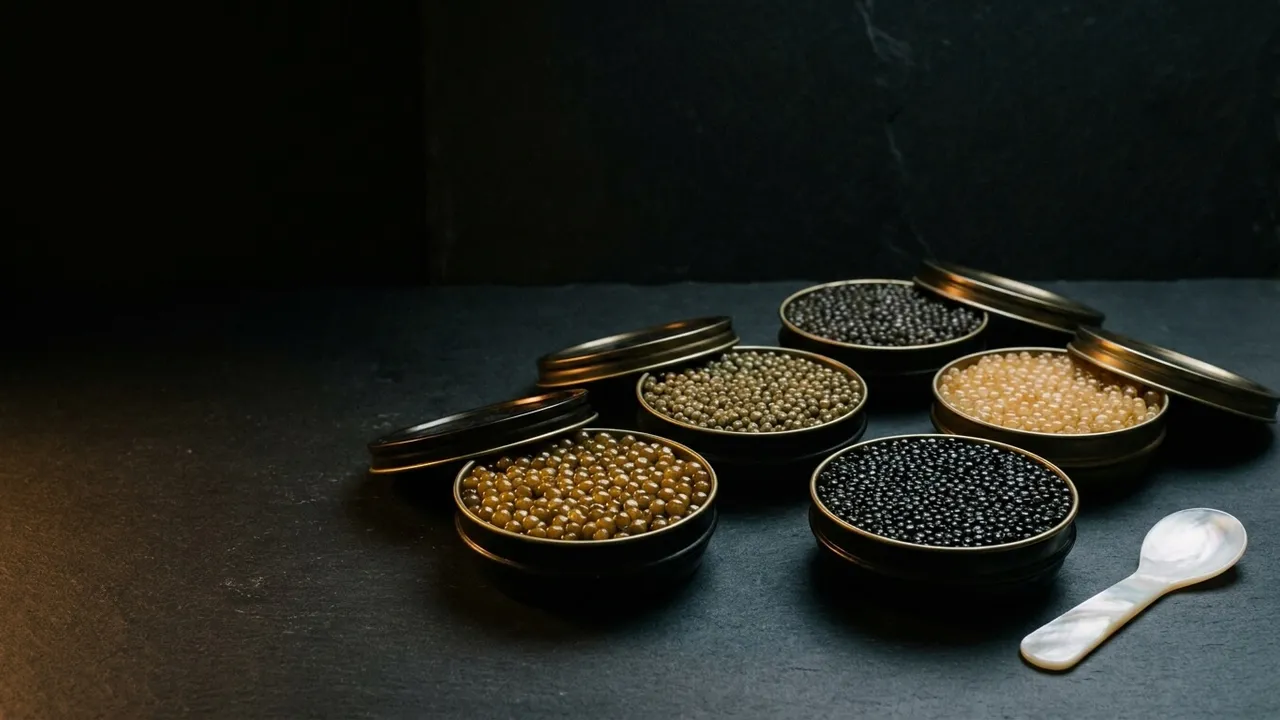
Types of Caviar: 9 Varieties Explained, With Real Prices
Nine types of caviar are sold in the United States: Beluga, Kaluga, Ossetra, Sevruga, Siberian, Sterlet, Hackleback, Paddlefish and Bowfin. Seven come from true sturgeon, one comes from a sturgeon relative, and one comes from a fish that is neither. Prices run from $11.71 to $130 per ounce. This guide gives the pearl size, flavour and price of each, and says which one to buy first.
Reviewed by Awers Inc. — 6 August 2026. Awers Inc. has cured and packed its own caviar in Bellevue, Washington since 1995.
What counts as caviar?
Caviar is the salted roe of fish in the order Acipenseriformes, which covers all sturgeon and the paddlefish. Under that definition, eight of the nine varieties below are caviar and one, Bowfin, is a caviar substitute. Roe from salmon, trout, lumpfish and flying fish is sold as caviar in US shops but sits outside the strict definition.
Two terms appear on almost every tin, and both describe process rather than quality.
Malossol is Russian for “little salt”. It describes a cure of 3 to 5 percent salt, low enough that the roe tastes of the fish rather than the brine. Malossol is a cure specification, not a grade.
Pasteurized means the roe was heat-treated after curing. Pasteurized caviar keeps far longer unopened and ships with less risk, at the cost of some texture. Fresh caviar has a cleaner pop and a shorter life.
Every sturgeon species is listed under CITES Appendix II, the international treaty controlling trade in species at risk. Legally imported sturgeon caviar carries a CITES label recording the species, the source, the country of origin and the year.
The 9 types of caviar at a glance
The three classic Caspian varieties are Beluga, Ossetra and Sevruga. Kaluga, Siberian and the American species have joined them as farming replaced wild harvest.
| Type | Species | Pearl size | Colour | Flavour | Sold by us |
|---|---|---|---|---|---|
| Beluga | Huso huso | 3.5 mm+ | Pale to dark grey | Creamy, mild | No — banned from US import |
| Kaluga Hybrid | Huso dauricus × A. schrenckii | Over 3.0 mm | Golden to dark brown | Strong, buttery | Yes |
| Ossetra | Acipenser gueldenstaedtii | 2.9 mm | Olive green to dark grey | Nutty, brisk | Yes |
| Sevruga | Acipenser stellatus | 2.0–2.5 mm | Dark grey to black | Bold, assertive, saline | No |
| Siberian | Acipenser baerii | 2.5 mm | Dark brown to black | Earthy, smooth | No |
| Sterlet | Acipenser ruthenus | 2.0 mm | Grey to golden | Delicate, sweet | No |
| Hackleback | Scaphirhynchus platorynchus | 2.0–2.5 mm | Jet black | Earthy, nutty | No |
| Paddlefish | Polyodon spathula | 2.5 mm | Grey | Nutty, earthy | Yes |
| Bowfin | Amia calva | 2.0 mm | True black | Firm, distinct | Yes |
Beluga caviar
Beluga caviar cannot be imported into or exported from the United States in any quantity. The US Fish and Wildlife Service listed the beluga sturgeon, Huso huso, as threatened under the Endangered Species Act in 2004. A 2005 special rule would have allowed trade to continue, but the countries harvesting beluga never filed the conservation plans it required, and imports were suspended that year. The moratorium still stands as of August 2026.
A narrow exemption route exists for aquaculture facilities outside the beluga’s range. Anyone offering you imported, Caspian or wild Beluga in the US is selling something mislabelled, smuggled, or both. See is Beluga caviar legal in the USA for the full position and the sources.
Beluga produces the largest pearls of any sturgeon, above 3.5 mm, pale to dark grey, with a creamy texture and a mild finish. The fish takes 18 to 20 years to reach maturity. That is why it was fished to the brink, and why it commanded the highest prices in the trade.
What is sold in the US as “Beluga hybrid” is a cross, usually Kaluga with Beluga. Read the label. If it does not say hybrid and it does not carry a CITES tag, walk away. For the full picture, see why Beluga cannot be imported.
The closest legal equivalent is Kaluga. It is the same genus, Huso, with a comparable pearl size and a similar weight on the palate.
Kaluga caviar
Kaluga caviar has the largest pearls legally available in the United States, at over 3.0 mm. The roe ranges from golden to dark brown, and the flavour is strong and buttery with a clean marine finish. It is sometimes called river Beluga, because Huso dauricus is the beluga sturgeon’s closest relative.
Almost all Kaluga on the US market is a hybrid of Kaluga and Amur sturgeon, farmed rather than wild. The hybrid matures faster than pure Kaluga and produces roe of comparable size, which is what made it affordable enough to displace Beluga after 2005.
- Pearl size: over 3.0 mm
- Colour: golden to dark brown
- Flavour: strong, buttery, clean finish
- Cure: malossol, no preservatives
- Best for: a first tin, and anyone who wants the Beluga experience legally
Our own Kaluga Hybrid caviar is aquacultured and cured malossol.
Ossetra caviar
Ossetra caviar is the classic reference flavour, and the variety most people mean when they say caviar. The pearls measure about 2.9 mm, ranging from olive green and pale yellow to dark grey. The taste is nutty and briskly saline with a faint sweetness. The texture is firmer than Kaluga.
Ossetra comes from Acipenser gueldenstaedtii, the Russian sturgeon. The species name is not a statement of origin. Russian sturgeon is farmed across Europe, Israel, China and the United States, and Russian-origin seafood cannot currently be imported into the US.
Four grade names appear on Ossetra tins and all four describe the fish, not the quality of the cure. Classic comes from standard-age sturgeon. Royal and Imperial come from older fish with larger, darker pearls. Golden Ossetra is the rare amber roe of mature sturgeon and costs several times the standard grade.
Spellings vary. Ossetra, Osetra and Oscietra are transliterations of one Russian word for one species. Our Ossetra caviar uses the double-S spelling on the label.
Sevruga caviar
Sevruga caviar is the boldest of the three classic Caspian varieties and the cheapest. The pearls are small, 2.0 to 2.5 mm, dark grey to black, with an assertive saline flavour that carries further than Ossetra on a blini.
Sevruga comes from Acipenser stellatus, the stellate sturgeon. The fish matures in seven years against the beluga’s twenty, which historically kept Sevruga in supply and kept the price down. Wild Caspian Sevruga is now heavily restricted, and farmed stellate sturgeon is uncommon outside Europe. We do not stock it.
Siberian sturgeon caviar
Siberian sturgeon caviar tastes earthy and smooth, with a long creamy finish and pearls around 2.5 mm in dark brown to black. It is the workhorse of European aquaculture, because Acipenser baerii matures in seven to eight years and adapts well to farming.
Siberian caviar is often sold under the name Baerii. It is a common house caviar in restaurants that want sturgeon roe at a working price. We do not stock it.
Sterlet caviar
Sterlet caviar has the smallest pearls of the farmed sturgeon varieties, around 2.0 mm, grey to golden, with a delicate and slightly sweet flavour. Acipenser ruthenus is a small freshwater sturgeon that was historically the caviar of the Russian court.
Sterlet is rare in the United States. Production is concentrated in central Europe and volumes are low. We do not stock it.
Hackleback caviar
Hackleback caviar is jet black with a firm texture and an earthy, nutty flavour, in pearls of 2.0 to 2.5 mm. It comes from the shovelnose sturgeon, Scaphirhynchus platorynchus, a small wild sturgeon native to the Mississippi and Missouri river basins.
Hackleback is a true sturgeon and a genuinely American caviar. It is usually the least expensive real sturgeon roe on the US market, which makes it a common entry point in tasting sets. We do not stock it.
Paddlefish caviar
Paddlefish caviar is grey, medium-pearled at around 2.5 mm, and tastes nutty and earthy with a mineral finish. It comes from the American paddlefish, Polyodon spathula, harvested wild in the Mississippi River basin.
Paddlefish is closely related to sturgeon. It sits in the same order, Acipenseriformes, but in its own family, and it is not a sturgeon. Guides that call it American sturgeon are wrong on the taxonomy even where they are right on the flavour.
At $19.14 per ounce against Ossetra’s $30.57, Paddlefish caviar is the most credible way to serve real Acipenseriformes roe to a large table. Ours is pasteurized, which extends the unopened shelf life considerably.
Bowfin caviar
Bowfin caviar is not sturgeon roe. Amia calva belongs to the order Amiiformes, an older lineage entirely, and it is not an Acipenseriform. Anyone selling Bowfin as sturgeon caviar is mislabelling it.
What Bowfin offers is the only naturally true-black roe on the market. The pearls run around 2.0 mm, firm, with a distinct mineral flavour and no dye of any kind. Lumpfish caviar achieves its black colour with food dye. Bowfin does not need to.
Bowfin is wild-harvested, largely in Louisiana, where the fish is known as choupique. Bowfin is the least expensive product we carry by a wide margin. It is the honest answer when someone asks what black roe costs under $50. See Bowfin caviar.
What about salmon roe, trout and lumpfish?
Salmon roe, trout roe, lumpfish roe and tobiko are sold as caviar in the United States but fall outside the Acipenseriformes definition. They are worth knowing because they occupy the price tier below Bowfin, and because two of them are genuinely good.
| Substitute | Source | Pearl size | Notes |
|---|---|---|---|
| Salmon roe (ikura) | Pacific salmon | 4–6 mm | Large orange pearls, sweet and briny. The best value in roe. |
| Trout roe | Rainbow trout | 3–4 mm | Bright orange, mild, popular as a garnish |
| Lumpfish roe | Cyclopterus lumpus | 1 mm | Dyed black or red. Firm, salty, inexpensive |
| Tobiko | Flying fish | 0.8 mm | Crunchy, faintly sweet. A sushi ingredient |
Salmon roe is the one worth taking seriously. Chum and coho roe from Alaska carries a clean sweetness that no sturgeon caviar has, and it costs a fraction of the price. It is a different product rather than a lesser one.
How much does each type of caviar cost?
Caviar costs between $11.71 and $130 per ounce in the United States as of August 2026. Species accounts for most of that spread, and tin size accounts for the rest. Larger tins always cost less per ounce.
Ranked from cheapest to most expensive:
| Type | Price per ounce | Source |
|---|---|---|
| Lumpfish (substitute) | $3–$6 | Typical US retail |
| Bowfin (substitute) | $11.71–$12.00 | Our catalogue |
| Hackleback | $18–$30 | Typical US retail |
| Paddlefish | $19.14 | Our catalogue |
| Siberian | $25–$40 | Typical US retail |
| Ossetra | $26.88–$37.71 | Our catalogue |
| Kaluga Hybrid | $28.52–$31.43 | Our catalogue |
| Sevruga | $30–$55 | Typical US retail |
| Golden Ossetra | $90–$130 | Typical US retail |
| Beluga | Cannot be imported | See note below |
Prices marked “our catalogue” are current at usablackcaviar.com as of August 2026. Ranges marked typical US retail are indicative for varieties we do not stock. For the full breakdown, see what caviar costs per ounce.
The most expensive type of caviar legally available in the US is Golden Ossetra, the amber roe of mature Russian sturgeon, which reaches $130 per ounce. Almas, the pale roe of albino beluga sturgeon, is often cited as the world’s most expensive caviar. It cannot be sold in the United States at all.
Which type of caviar should you buy first?
Buy Kaluga Hybrid first. It has the largest legal pearls and a buttery flavour that forgives a first attempt at serving. It sits at the same price as Ossetra. Ranked on approachability for a first-time buyer, Kaluga is first, Ossetra second, Paddlefish third.
Three other cases have different answers:
- If you want the reference flavour, buy Ossetra. It is the taste against which caviar people calibrate everything else, nuttier and firmer than Kaluga.
- If you are serving more than ten people, buy Paddlefish. It is real Acipenseriformes roe at $19.14 per ounce against Ossetra’s $30.57, and no one at a table of twelve is conducting a tasting.
- If you want true black roe under $50, buy Bowfin. It is the only undyed black caviar substitute at that price, and it is honest about what it is.
Allow 12 to 15 grams per person as an appetiser, or 30 grams if caviar is the centre of the course. A 100 gram tin serves six to eight people at appetiser portions. Once you have chosen, read how to serve it.
Frequently asked questions
What are the three main types of caviar? The three main types of caviar are Beluga, Ossetra and Sevruga, the classic varieties of the Caspian Sea. Of the three, only Ossetra is legally sold in the United States in any volume.
How many types of caviar are there? Nine types of caviar are commonly sold in the United States: Beluga, Kaluga, Ossetra, Sevruga, Siberian, Sterlet, Hackleback, Paddlefish and Bowfin. Seven are true sturgeon, Paddlefish is a sturgeon relative, and Bowfin is neither.
Why is Beluga caviar illegal in the US? Beluga caviar is banned under a 2005 US Fish and Wildlife Service prohibition on Caspian beluga imports. The agency had listed the beluga sturgeon as threatened under the Endangered Species Act a year earlier. The species takes about 20 years to mature and wild stocks collapsed under fishing pressure.
Is salmon roe caviar? No, not under the strict definition. Caviar is the salted roe of fish in the order Acipenseriformes, which covers sturgeon and paddlefish. Salmon roe is sold as red caviar in the United States and is an excellent product, but it comes from a different order of fish.
What type of caviar is black? Bowfin caviar is the only naturally true-black roe on the US market. Hackleback is close to jet black, and Sevruga and Siberian run dark grey to black. Lumpfish roe is black only because it is dyed.
What is the best type of caviar for beginners? Kaluga Hybrid is the best type of caviar for beginners. Its large pearls and buttery flavour are forgiving, it costs about the same as Ossetra, and it is the closest legal equivalent to Beluga.
In summary
Nine types of caviar reach the US market. Beluga is banned. Kaluga has the largest legal pearls at over 3.0 mm and is the best first tin. Ossetra at 2.9 mm is the reference flavour. Sevruga, Siberian, Sterlet and Hackleback fill the space beneath them. Paddlefish is a sturgeon relative at $19.14 per ounce, and Bowfin, which is not a sturgeon at all, is the only naturally black roe under $50 an ounce. Real caviar starts at $11.71 per ounce and the most expensive variety legally sold in the United States is Golden Ossetra at up to $130.