Guide
What Is Black Caviar? Fish, Origin and Real Prices
Black caviar is the salted roe of sturgeon and its close relatives, sold in tins and jars and eaten raw. It costs between $12 and $130 per ounce in the United States as of August 2026. The name is a translation from Russian rather than an English term, and the roe itself is usually grey, amber or brown rather than black.
Reviewed by Awers Inc. — 6 August 2026. Awers Inc. has cured and packed its own caviar in Bellevue, Washington since 1995.
What is black caviar?
Black caviar is the salted roe of fish in the order Acipenseriformes, which covers every sturgeon species and the paddlefish. The roe is separated from the membrane, cured with salt, and packed without cooking. Nothing is added beyond salt in a proper malossol cure.
Two things distinguish black caviar from every other fish roe on the market. The fish is a sturgeon or a sturgeon relative, and the cure is minimal. Everything else, including grade names, tin colours and marketing language, describes variation within that.
Nine varieties reach the United States. For the full comparison of pearl size, flavour and price, see types of caviar.
Why is it called black caviar?
The term “black caviar” is a direct translation of the Russian чёрная икра, and it exists to contrast with красная икра, red caviar, which is salmon roe. Both terms are everyday vocabulary in Russia, Ukraine, Poland and across Eastern Europe, where the two products sit side by side on the same table.
English has no equivalent pairing. Americans say “caviar” when they mean sturgeon roe and “salmon roe” or “ikura” when they mean the orange kind. The word “black” is doing no work in an English sentence, which is why you rarely see it on a French or American menu.
The distinction matters practically. Anyone searching for black caviar in the United States is probably shopping in a vocabulary that came from somewhere else. The American seller they find may file the same product under sturgeon caviar, or simply caviar. They are the same thing. Search both terms.
What fish does black caviar come from?
Black caviar comes from sturgeon, an order of fish that has existed for more than 200 million years. Seven sturgeon species and one sturgeon relative supply the roe sold in the United States.
- Ossetra — Russian sturgeon, Acipenser gueldenstaedtii
- Kaluga — Huso dauricus, usually crossed with Amur sturgeon
- Beluga — Huso huso, banned from US import since 2005
- Sevruga — stellate sturgeon, Acipenser stellatus
- Siberian — Acipenser baerii
- Sterlet — Acipenser ruthenus
- Hackleback — shovelnose sturgeon, Scaphirhynchus platorynchus
- Paddlefish — Polyodon spathula, a sturgeon relative rather than a sturgeon
Bowfin roe is also sold as black caviar, and it is not sturgeon roe. Amia calva belongs to a separate and older order. It is a caviar substitute, and a good one, but the label should say Bowfin.
Nearly all sturgeon caviar sold today is farmed. Wild Caspian harvest has been closed to international trade for two decades. The sturgeon in the tin was almost certainly raised in an aquaculture facility in Europe, Israel, China or the United States.
Why is caviar black, and why is it often not?
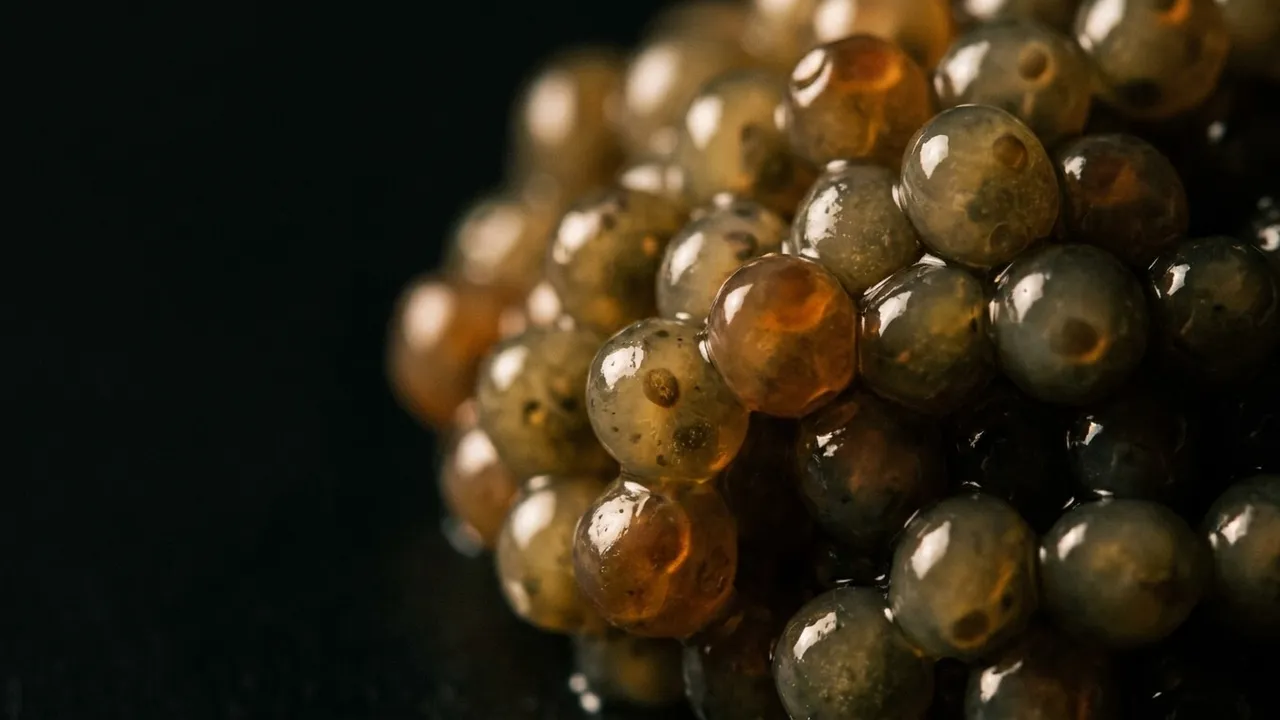
Sturgeon roe is dark because of melanin pigment in the egg membrane, in the same way that hair and skin are pigmented. The amount varies by species, by the age of the fish and by diet, which is why colour ranges so widely.
Most black caviar is not black. It is grey, olive, amber or brown. Colour describes the fish, not the quality. Paler roe from older sturgeon usually costs more, not less.
| Variety | Actual colour |
|---|---|
| Ossetra | Olive green, pale yellow to dark grey |
| Kaluga Hybrid | Golden to dark brown |
| Golden Ossetra | Amber to gold |
| Sevruga | Dark grey to black |
| Hackleback | Jet black |
| Paddlefish | Grey |
| Bowfin | True black, naturally |
Only Bowfin roe is reliably black without help. Lumpfish roe reaches its black colour through food dye, which is a separate matter covered below.
Black caviar vs red caviar
Black caviar is sturgeon roe and red caviar is salmon roe. They come from different orders of fish, differ by a factor of ten in price, and are not substitutes for one another.
| Black caviar | Red caviar | |
|---|---|---|
| Fish | Sturgeon and relatives | Pacific and Atlantic salmon |
| Pearl size | 2.0–3.5 mm | 4–6 mm |
| Colour | Grey, olive, amber, brown | Orange to deep red |
| Flavour | Nutty, briny, mineral | Sweet, briny, richer |
| Texture | Firm, fine pop | Large, bursting |
| Typical US price | $12–$130 per ounce | $2–$6 per ounce |
| Common name in the US | Caviar, sturgeon caviar | Salmon roe, ikura |
Red caviar is not a lesser product. It is a different one, with a sweetness no sturgeon roe has, and it is what most Eastern European households actually eat. Black caviar is the rarer and dearer of the two. Sturgeon take seven to twenty years to mature; salmon spawn within four.
Why is black caviar so expensive?
Black caviar is expensive because sturgeon take years to produce roe and can only be harvested once. A Russian sturgeon reaches maturity at around eight to twelve years. A beluga sturgeon takes 18 to 20.
Three costs stack on top of that. Aquaculture means feeding and housing a large fish for a decade before it returns anything. Curing is skilled hand work, graded and salted by a master rather than a machine. And every sturgeon species is listed under CITES Appendix II, which adds permits, labelling and inspection to every shipment.
Wild harvest collapsed for the same reason. Caspian sturgeon stocks fell far enough that international trade closed, and farming replaced them at a higher cost per ounce.
How much does black caviar cost?
Black caviar costs between $12 and $130 per ounce in the United States as of August 2026. The variety accounts for most of the range and the tin size accounts for the rest.
At the accessible end, Bowfin caviar runs $11.71 per ounce. In the middle, Ossetra and Kaluga Hybrid sit between $26.88 and $37.71. At the top, Golden Ossetra reaches $130.
Larger tins always cost less per ounce. Our 454 gram Ossetra works out 12% cheaper per ounce than the 100 gram tin of the same roe.
Is black lumpfish caviar real caviar?
No. Black lumpfish caviar is dyed roe from the lumpfish, Cyclopterus lumpus, and it is not sturgeon roe. It is the small, intensely black, slightly crunchy roe sold in supermarket jars for a few dollars.
The colour comes from food dye. That is why lumpfish roe stains everything it touches and bleeds into whatever it sits on. Real black caviar does not run.
Lumpfish roe is a legitimate ingredient at its own price, at $3 to $6 per ounce. It is not a substitute for sturgeon roe and should not be sold as one. If you want genuinely black roe that is not dyed, Bowfin is the honest answer at around $12 per ounce.
Frequently asked questions
What is black caviar made of? Black caviar is made of sturgeon roe and salt. The eggs are separated from the membrane by hand, cured with 3 to 5 percent salt, and packed without cooking or preservatives.
Where does black caviar come from? Black caviar comes from farmed sturgeon raised in aquaculture facilities in Europe, Israel, China and the United States. Wild Caspian sturgeon harvest has been closed to international trade for two decades.
Is black caviar the same as sturgeon caviar? Yes, in almost every case. Black caviar and sturgeon caviar describe the same product. The exception is Bowfin roe, which is sold as black caviar but comes from a fish that is not a sturgeon.
Is black caviar dyed? No. Genuine sturgeon caviar is never dyed and its colour comes from natural pigment in the egg membrane. Black lumpfish roe is dyed, which is a different and much cheaper product.
What are the types of black caviar? The main types of black caviar are Ossetra, Kaluga, Beluga, Sevruga, Siberian, Sterlet, Hackleback and Paddlefish, plus Bowfin as a substitute. See types of caviar for the comparison.
How do you eat black caviar? Eat black caviar cold, straight from the tin, with a mother-of-pearl spoon, allowing 12 to 15 grams per person as an appetiser. See how to eat and serve caviar.
In summary
Black caviar is the salted roe of sturgeon and sturgeon relatives, eaten raw and packed without preservatives. The name is a translation of the Russian чёрная икра, coined to contrast with red salmon caviar, and it is rarely an accurate description of the colour. Most black caviar is grey, olive or amber. It costs $12 to $130 per ounce in the United States as of August 2026. It is expensive because sturgeon take eight to twenty years to mature.